The Drone Revolution in the Russia–Ukraine War: An Invitation to the Frontline
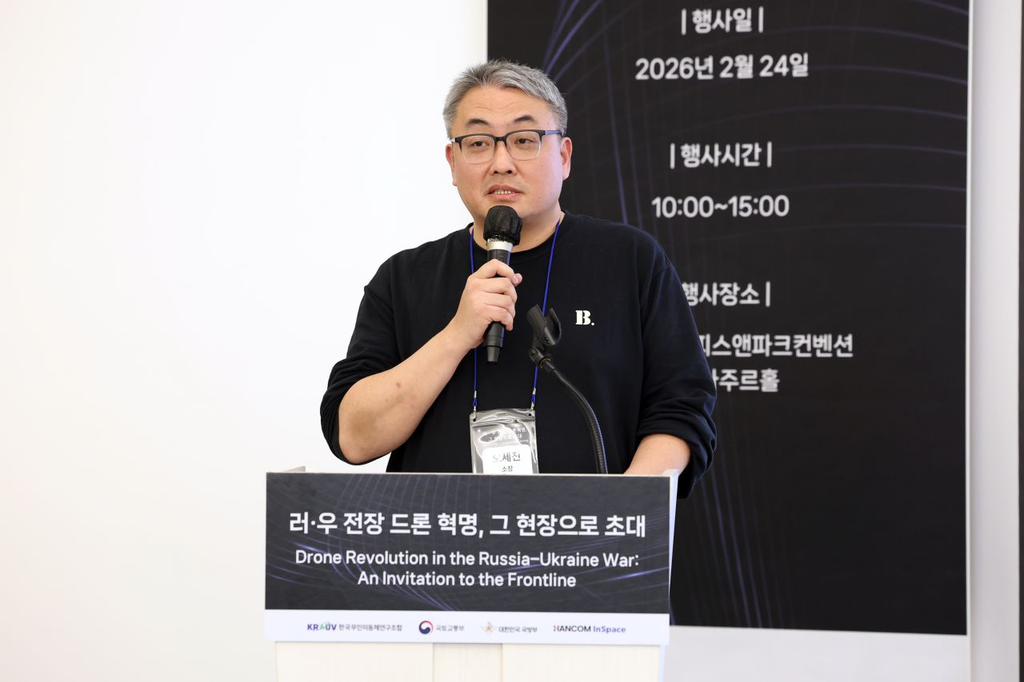
FineVT Presents Battlefield Lessons, Blue UAS Strategy, and Practical Export Pathways for the Korean Drone Industry
The seminar titled “The Drone Revolution in the Russia–Ukraine War: An Invitation to the Frontline” was held on 24 February 2026 at the Peace & Park Convention Center of the War Memorial of Korea in Seoul.
The seminar was hosted by the Ministry of National Defense, the Ministry of Land, Infrastructure and Transport, and KRAUV, bringing together approximately 150 experts and representatives from the military, government agencies, defense companies, research institutes, universities, and the private sector.
The event examined how the Russia–Ukraine War has fundamentally transformed the development, deployment, and sustainment of unmanned systems. It also provided Korean defense and drone companies with practical insights into battlefield requirements, operational validation, international certification, and overseas market-entry strategies.

Practical Insights from Organizations Engaged with Ukraine
JDI, a U.S.-based defense exporter supplying military equipment to Ukraine, and FineVT, a Korean defense and unmanned-systems company actively pursuing international cooperation, delivered a series of presentations on the operational realities and technological changes emerging from the Ukrainian battlefield.
The presentations addressed:
- The rapidly changing role of drones in modern warfare
- Operational requirements identified by Ukrainian military personnel
- Battlefield tactics involving UAV, UGV, and USV platforms
- Electronic warfare and GNSS-disrupted operating environments
- Counter-UAS threats and response concepts
- Short technology-upgrade cycles based on field feedback
- Testing and validation under realistic operational conditions
- Defense-export strategies for Korean drone companies
- International cooperation and localization requirements
- Maintenance, repair, sustainment, and supply-chain considerations
Because detailed information concerning actual operations in Ukraine is often restricted for security reasons, the seminar was conducted as a closed-door event to facilitate the responsible sharing of verified and practical information.
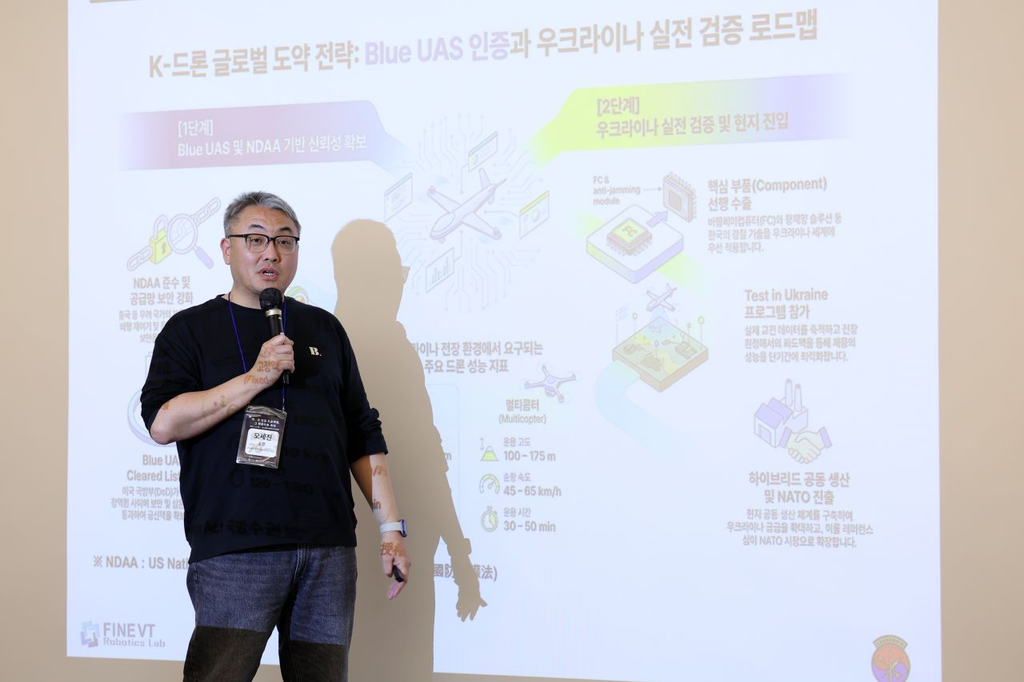
Presentation by Sejin Oh, Director of FineVT Robotics LAB
During the seminar, Sejin Oh, Director of FineVT Robotics LAB, delivered a presentation on the evolving global UAS market, the United States-centered Blue UAS framework, and a practical pathway for validating Korean unmanned systems through operational evaluation in Ukraine.
Director Oh explained that overseas defense exports require more than competitive performance specifications or product demonstrations. Systems intended for modern military operations must also demonstrate cybersecurity, supply-chain reliability, interoperability, resilience against electronic warfare, operational suitability, maintainability, and the ability to respond rapidly to feedback from end users.
His presentation introduced a field-oriented evaluation model under which selected equipment may be submitted to appropriate Ukrainian organizations for controlled assessment. Subject to governmental authorization, security requirements, export-control regulations, and agreements with the relevant Ukrainian authorities, the evaluation process may include:
- Preliminary technical and security review
- Definition of mission requirements and evaluation criteria
- Delivery of approved equipment for controlled testing
- Operational assessment by authorized Ukrainian users
- Collection of performance data and user feedback
- Identification of technical limitations and improvement requirements
- Product modification and software or hardware upgrades
- Retesting and preparation of operational references
- Development of an export and localization strategy
This model is intended to reduce the gap between laboratory performance and actual operational requirements. It can also provide Korean manufacturers with meaningful data for improving reliability, interoperability, survivability, and ease of maintenance.
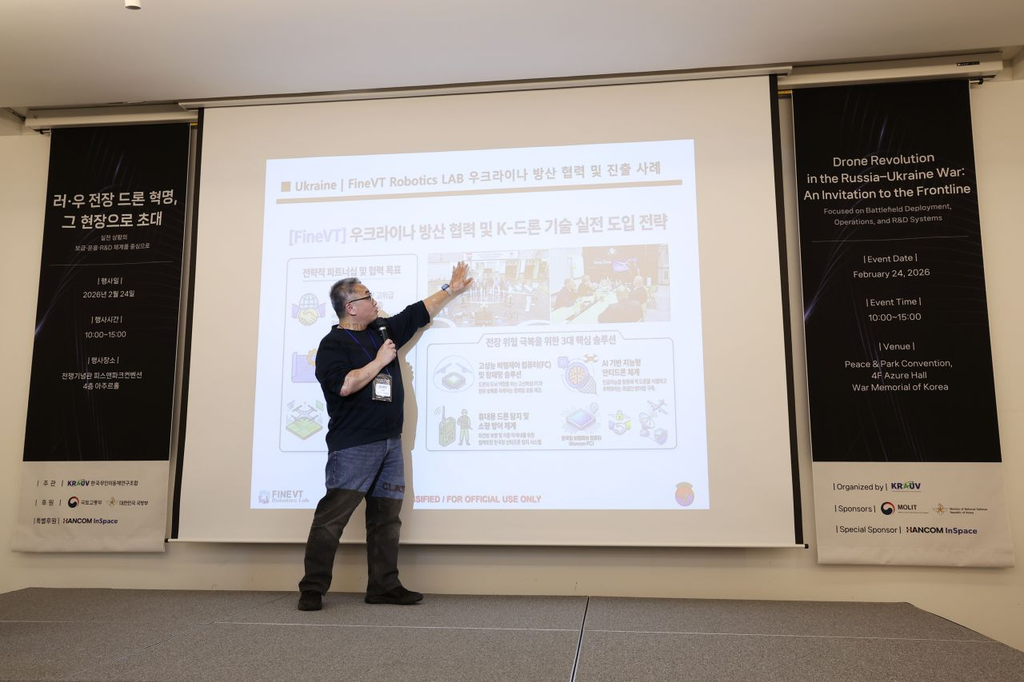
Understanding the Blue UAS Framework
Director Oh also presented the strategic importance of the U.S. Blue UAS framework for companies seeking to enter U.S. government and allied defense markets.
Rather than treating Blue UAS as a conventional product certification alone, the presentation described it as a trusted-UAS pathway involving security assessment, policy compliance, supply-chain visibility, component origin, software assurance, operational performance, and acquisition eligibility.
Key preparation areas highlighted during the presentation included:
- Cybersecurity architecture
- Secure command-and-control communications
- Protection of operational and mission data
- Software and firmware vulnerability management
- Secure boot and trusted-update mechanisms
- Supply-chain and component traceability
- Modular open-systems architecture
- Interoperability with U.S. and allied payloads
- Operational testing and technical documentation
- Maintenance and lifecycle-support planning
FineVT emphasized that Korean companies should prepare for these requirements from the initial design stage rather than attempting to address them only after product development has been completed.
The presentation did not represent that every FineVT platform had already obtained Blue UAS approval. Instead, it introduced a practical strategy for developing Blue UAS-aligned technologies and preparing Korean companies for future trusted-UAS assessment, international collaboration, and U.S. market entry.
Differences Between Ukrainian and Korean Unmanned-System Operations
The FineVT Robotics LAB presentation attracted considerable attention because it was based on official Ukrainian materials, operational reports, and verified information available through FineVT’s international cooperation network.
The presentation compared Ukrainian and Korean approaches to the operation of Unmanned Aerial Vehicles, Unmanned Ground Vehicles, and Unmanned Surface Vehicles.
In Ukraine, unmanned systems are frequently developed and modified through a rapid cycle connecting military users, engineers, manufacturers, volunteers, and field-support teams. Operational feedback is quickly reflected in airframe design, software, communications, payload configuration, electronic protection, and tactics.
The Korean approach has traditionally placed greater emphasis on structured acquisition, formal testing, safety verification, standardization, and long-term lifecycle management. These procedures remain essential, particularly for systems integrated with national defense networks and military command structures.
FineVT proposed that Korea combine the strengths of both approaches:
- Korea’s structured testing, certification, quality assurance, and system integration
- Ukraine’s rapid field feedback and short development cycles
- U.S. trusted-UAS cybersecurity and supply-chain requirements
- NATO-oriented interoperability and operational standards
- Continuous software and mission-system upgrades
- User-centered development based on combat experimentation
This combined model could help Korean companies shorten development cycles while maintaining the reliability, security, and quality required for military deployment and export.
Transformation of the Modern Battlefield
The Russia–Ukraine War has demonstrated that unmanned systems are no longer supplementary assets. UAVs, UGVs, and USVs are becoming central components of reconnaissance, targeting, communications, logistics, force protection, and strike operations.
The seminar highlighted several important battlefield developments:
Rapid Innovation Cycles
Drone hardware, communications protocols, navigation systems, payloads, and operational software are continually modified in response to new threats. Equipment that performs successfully at one stage of a conflict may become vulnerable within a short period as opposing forces introduce new electronic-warfare capabilities or tactics.
Electronic Warfare as a Core Operational Requirement
Modern unmanned systems must operate in environments affected by jamming, spoofing, signal interception, communications disruption, and cyber threats. Communications resilience and navigation alternatives are therefore becoming fundamental design requirements.
Increased Demand for Autonomous Capabilities
AI-based navigation, target recognition, route planning, sensor fusion, and mission management can reduce operator workload and improve mission continuity when communications or GNSS signals are degraded.
Importance of Interoperability
Individual platforms must be connected with sensors, command-and-control systems, tactical networks, manned platforms, and other unmanned assets. Open architecture and standardized interfaces are essential for MUM-T and multi-domain operations.
Sustainment as an Operational Capability
A platform’s value depends not only on flight performance but also on the availability of spare parts, field repair, software updates, maintenance personnel, training, and supply-chain support.
FineVT Robotics LAB’s Core Business Capabilities
FineVT Robotics LAB conducts research, development, system integration, testing, and commercialization across air, ground, maritime, communications, and defense-training domains.
Its principal business and technology areas include:
- Fixed-wing and VTOL UAV platforms
- MALE-class ISR UAV technologies
- Tactical surveillance and reconnaissance UAVs
- UGV and USV technologies
- AI-based autonomous flight and mission management
- Manned–Unmanned Teaming
- Multi-UAV and multi-domain collaboration
- UAV Traffic Management and integrated control
- ROS 2 and DDS-based interoperability
- Secure command-and-control data links
- 5G, LTE, satellite, and tactical communications
- Anti-jamming and GNSS spoofing-countermeasure technologies
- C4ISR and tactical-network integration
- AI-based digital twins and combat experimentation
- VR/MR Counter-UAS training simulation
- Quantum-secure communications using PQC, QRNG, and QKD
FineVT’s development philosophy is centered on integrated mission capability. The company combines unmanned platforms with sensors, payloads, communications, AI, electronic protection, cybersecurity, command and control, simulation, training, and lifecycle support.
FineVT’s Counter-UAS and Electronic Warfare Capabilities
Through cooperation between FineVT Robotics LAB and FineVT E/W & Security LAB, FineVT is developing a layered Counter-UAS architecture covering the entire operational cycle.
The architecture may incorporate:
- Two-dimensional and three-dimensional radar
- RF scanning and protocol analysis
- EO/IR surveillance systems
- Acoustic detection
- AI-based sensor fusion
- Drone classification and threat assessment
- Integrated command and control
- Electronic-support and electronic-protection technologies
- Soft-kill and hard-kill system integration
- AI-supported mission analysis
- Training, simulation, and after-action review
FineVT is also researching resilient communications and navigation technologies to improve the survivability of friendly unmanned systems under jamming, spoofing, cyber intrusion, and communications-denied conditions.
Combat Experimentation-Based Export Strategy
One of the principal messages delivered by Director Oh was that Korean drone companies should move beyond conventional product-centered export models.
A successful defense-export strategy should demonstrate how a complete operational solution performs under realistic mission conditions. This requires cooperation among military users, government agencies, research institutions, local partners, and manufacturers.
FineVT’s proposed export model consists of:
- Analysis of each country’s security priorities
- Identification of actual operational requirements
- Development of mission-specific configurations
- Verification through simulation and combat experimentation
- Field testing with authorized end users
- Interoperability assessment
- Cybersecurity and supply-chain review
- Collection of operational feedback
- Rapid product improvement
- Establishment of local manufacturing and MRO partnerships
- Development of long-term training and sustainment programs
Operational evaluation in Ukraine could provide an important reference for this model, but participation must be managed carefully in compliance with Korean and international laws, export controls, end-user requirements, security restrictions, and governmental approval procedures.
Contributions from the Agency for Defense Development
Researchers from the Agency for Defense Development also participated in the seminar and presented their perspectives on the future development of the Korean defense industry and defense exports.
Their participation provided valuable strategic direction concerning the relationship between national defense research, emerging technologies, military requirements, and industrial competitiveness.
The seminar demonstrated the importance of connecting government policy, military operational experience, national research capabilities, and private-sector innovation within a unified defense-technology ecosystem.
Need for Continued Closed-Door Seminars
The seminar also highlighted the need for continued interministerial cooperation.
Future closed-door seminars involving the Ministry of National Defense, the Ministry of Land, Infrastructure and Transport, the Ministry of Trade, Industry and Energy, the Ministry of Science and ICT, and other relevant organizations could provide a trusted forum for sharing verified information.
Such meetings could address:
- Changes in overseas battlefield requirements
- International UAS and Counter-UAS policies
- Export-control and regulatory issues
- Blue UAS and trusted-supply-chain requirements
- NATO interoperability
- Overseas testing and operational validation
- Government support for defense exports
- International joint R&D
- Local manufacturing and sustainment
- Workforce development
- Public–private investment and financing
More frequent dialogue among industry, academia, military organizations, research institutions, and government agencies would help prevent fragmented investment and duplicated development.
Toward a Unified National K-Drone Strategy
FineVT believes that Korea requires an integrated national approach to strengthening the global competitiveness of the K-Drone industry.
This approach should connect:
- Military operational requirements
- Government R&D programs
- Commercial drone technologies
- AI and autonomous systems
- Electronic warfare and Counter-UAS capabilities
- Cybersecurity and quantum-secure communications
- International certification and standardization
- Overseas field testing
- Export financing and policy support
- Local production and MRO networks
FineVT Robotics LAB will continue sharing practical knowledge obtained through international cooperation and supporting Korean companies seeking opportunities in the global UAV, Counter-UAS, robotics, and defense markets.
Under the leadership of Director Sejin Oh, FineVT aims to connect Korean technology with verified operational requirements, develop trusted international partnerships, and create a sustainable pathway from research and development to battlefield validation and overseas export.
The seminar reaffirmed that the future competitiveness of Korea’s drone industry will depend not only on individual technologies but also on the country’s ability to integrate policy, research, manufacturing, operational experimentation, certification, and international cooperation into a unified national strategy.
#FineVT #FineVTRoboticsLAB #FineVTEWSecurityLAB #SejinOh #RussiaUkraineWar #Ukraine #UAV #UGV #USV #CounterUAS #ElectronicWarfare #BlueUAS #CombatExperimentation #DefenseExport #KDrone #MUMT #C4ISR #DefenseInnovation #ADD #KRAUV